Rate Optimization
Understanding cloud rate optimization strategies and how to achieve significant cost savings without impacting your infrastructure
Rate optimization refers to selecting the most cost-effective pricing options for your cloud resources based on your workload requirements and usage patterns. By optimizing your rates, you can significantly reduce your cloud costs without compromising on performance or flexibility.
What is Rate Optimization?

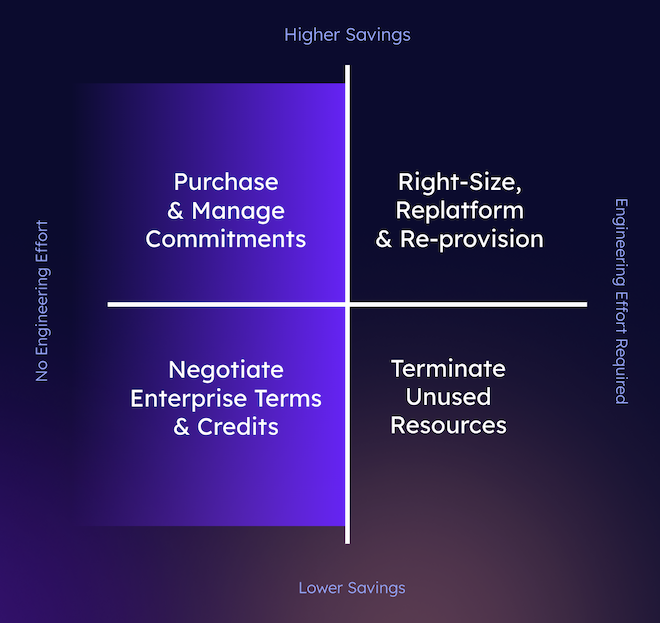
While all of the above methods reduce costs, the highlighted section on the left focuses on Rate Optimization because they don’t impact your running infrastructure. Instead, you get a better price, or rate, for infrastructure you are already using.
Why is Rate Optimization Important?
On-demand pricing in cloud services, while the most flexible, is the most expensive compared to other pricing options. Running your workloads solely on on-demand instances can lead to substantial costs, especially for long-running or persistent workloads.By implementing rate optimization strategies, you can potentially save 30% to 70% on your cloud bills, depending on your specific use case, service usage, and workload characteristics.
Understanding Your Current Costs
Before optimizing rates, you need visibility into your current spending patterns using native cloud cost management tools:
AWS Cost Tools
Cost and Usage Reports (CUR)
Detailed cost data
Resource-level breakdown
Usage patterns
Cost Explorer
Cost visualization
Trend analysis
Right-sizing recommendations
Azure Cost Tools
Cost Management + Billing
Cost analysis
Budgets and alerts
Optimization insights
Azure Advisor
Cost recommendations
Reserved instance guidance
Resource optimization
GCP Cost Tools
Billing Export
Billing data export
BigQuery analysis
Custom reporting
Cost Management
Budget monitoring
Commitment analysis
Utilization insights
Best Practice: Connect your billing data to Archera’s free platform for superior cost analysis and optimization recommendations. Archera provides better insights than native cloud tools while automatically identifying optimization opportunities.
What Rate Optimization is NOT
Returning to our four quadrants above - the unshaded areas on the right represent cost savings activities that do NOT fall under the umbrella of Rate Optimization. These are known as “usage optimization” - optimizing how you consume the cloud.
Native Rate Optimization Options
Cloud providers offer several native pricing options that can help you optimize your costs:
1. Reserved Instances (RIs)
RIs allow you to commit to a specific instance configuration for a term of 1 or 3 years, in exchange for a significant discount compared to on-demand pricing. RIs are suitable for steady-state, predictable workloads.
2. Savings Plans
Savings Plans offer a flexible pricing model that provides discounts on your compute usage. By committing to a certain amount of compute usage (measured in dollars per hour) for a 1 or 3-year term, you can receive discounts on EC2, Fargate, and Lambda usage.
3. Spot Instances
Spot Instances allow you to bid on spare compute capacity at a discounted rate, often up to 90% lower than on-demand prices. Spot Instances are suitable for interruption-tolerant workloads, such as batch processing, testing, or stateless applications.
4. Enterprise Discount Programs (EDP/PPA)
Enterprise Discount Programs / Private Pricing Agreements are offered on an ad-hoc basis to individual organizations based on their historical consumption. While there are no publicly defined guidelines for when an organization may be offered an EDP/PPA, these generally provide high-level discounts off public prices in exchange for multi-year, often multi-million dollar spend commitments.
Limitations of Native Options
While these native options offer significant cost savings, they also come with limitations and trade-offs:
Reserved Instances and Savings Plans require long-term commitments, reducing flexibility
Spot Instances can be interrupted with a 2-minute warning, which may not be suitable for all workloads
PPAs require significant investment, often with implied growth obligations
How Archera Integrates with Cost Management Tools
Archera works alongside your existing cost management tools to provide comprehensive optimization:
AWS Integration
Cost and Usage Reports (CUR)
Archera analyzes your CUR data for optimization opportunities
Identifies underutilized resources and commitment gaps
Provides recommendations based on detailed usage patterns
Cost Explorer Integration
Compare Archera recommendations with Cost Explorer forecasts
Validate savings projections using historical cost data
Monitor commitment performance alongside native AWS tools
Azure Integration
Cost Management + Billing
Leverages Azure cost data for intelligent recommendations
Analyzes spending trends and usage patterns
Integrates with existing budget and alert configurations
Ongoing Monitoring
Use Azure Cost Management to track Archera commitment performance
Compare actual vs projected savings in native dashboards
Maintain cost governance policies alongside optimization
Google Cloud Integration
Billing Export Analysis
Processes GCP billing data for optimization insights
Identifies CUD opportunities and usage patterns
Provides BigQuery-compatible cost analysis
Unified Reporting
Combine GCP native cost reporting with Archera insights
Track optimization impact using familiar GCP tools
Maintain existing cost monitoring workflows
The Archera Advantage
Archera’s platform addresses native commitment limitations by providing:
Risk Mitigation
Investment Protection
Insurance against unused capacity
Guaranteed savings realization
Professional management included
Multi-Cloud Strategy
Unified Management
Single platform for all cloud commitments
Cross-cloud optimization strategies
Consolidated reporting and analytics
Transfer Flexibility
Account Mobility
Transfer commitments between accounts
Reorganize cloud structure without losing savings
Support for M&A activities
Last updated
Was this helpful?

